Chinese Universities
Choose a Chinese University: 4 Crucial Steps
Learn how to choose a Chinese university in 2027 with accurate data on

Scholarship application and exam preparation support.
Practice tests, strategies, and feedback to help you achieve your target score.
Targeted training and past paper practice to boost your exam performance.
Mock interviews and coaching to help you succeed in admissions and visa interviews.


Imagine finding the ideal university degree, only to realize that waiting for scholarship committee decisions might delay your academic journey by an entire year. Opting for Self-Funding Studies in China bypasses that uncertainty entirely, securing your admission seat directly with transparent processing timelines and full control over your major.
When evaluating the basic financial criteria alongside academic self funded study in china requirements, the total annual budget generally ranges between 35,000 and 85,000 RMB (approximately 49,000 to 118,000 MAD), covering university tuition, housing, and standard living costs. Compared to Western destinations where a single semester can easily exceed that sum, China delivers world-class academic infrastructure at a fraction of the price.
The overall cost of studying in china for international students will depend heavily on your chosen degree and geographic location. Tier 1 economic hubs such as Shanghai command higher daily living budgets, whereas provincial tech and educational centers offer significantly lower housing and day-to-day costs.
Our team at Great Wall Education works closely with students and parents to evaluate regional variations in china university tuition fees for international students, helping you select programs that fit your academic goals and family budget.

Once you decide to bypass lengthy scholarship waiting lists, setting your exact academic budget is your essential first move. The baseline cost of studying in china for international students depends heavily on the subject you pursue and the language of instruction you choose.
Every institution sets its own pricing schedule, so treat the following table as a realistic planning benchmark for your 2027 entry:
| Academic Field | Annual Tuition (RMB) | Approximate Equivalent (MAD) |
|---|---|---|
| Chinese Language & Humanities | 14,000 to 22,000 RMB | 19,500 to 30,500 MAD |
| Engineering, Technology & Sciences | 18,000 to 30,000 RMB | 25,000 to 41,800 MAD |
| Business & Economics (English-taught) | 22,000 to 36,000 RMB | 30,600 to 50,000 MAD |
| Clinical Medicine (MBBS in English) | 30,000 to 45,000 RMB | 41,800 to 62,700 MAD |
Before you discover how to apply for self financed study in china, always verify the exact numbers directly on official department portals before submitting fees. As detailed in the Tsinghua University International Student Tuition and Fees schedule, institutional prestige, laboratory intensity, and municipal tiers create measurable variations across campuses.
You will quickly notice that programs delivered entirely in English carry a premium of roughly 20% to 35% over their Chinese-taught counterparts. Universities must recruit specialized bilingual faculty and license foreign-language academic databases, which directly influences china university tuition fees for international students.
Medical training commands the highest bracket, reaching up to 45,000 RMB per year. The reasons behind these higher medical fees include:
When planning for Self-Funding Studies in China with an eye toward a Chinese-taught undergraduate or postgraduate degree, you must first complete a preparatory language foundation. These intensive Chinese courses generally cost between 14,000 and 22,000 RMB for a full academic year. While you will pay out-of-pocket initially, keeping competitive grades during this preparatory stage lets you benchmark against the Chinese government scholarship 2027 requirements for potential municipal aid later.
Once you settle your tuition expectations, accommodation forms the second largest part of your budget. Your choice between university residence halls and off-campus housing directly shapes your total cost of studying in China for international students.
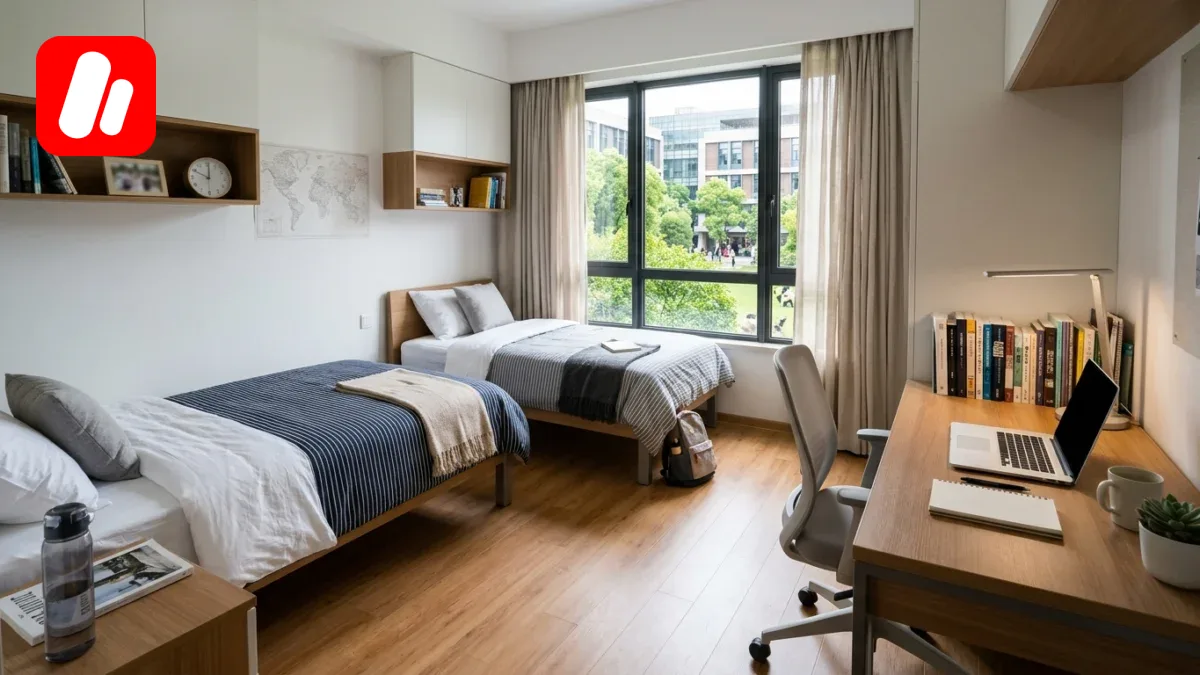
Meeting the initial self funded study in china requirements usually includes arranging your living quarters, and most universities host international students in dedicated residence halls. These buildings provide secure access, furnished living spaces, and simplified administrative routines that ease your initial arrival.
Housing costs vary widely by arrangement:
While renting independently offers privacy, private leases can noticeably increase the cost of studying in china for international students and introduce extra hurdles for new arrivals. Landlords typically demand a two-month security deposit upfront alongside the first month of rent. Monthly utilities for private flats often exceed 400 RMB due to heating and independent meter billing.
In addition to budgeting for china university tuition fees for international students, foreign residents must register their off-campus lease at the local police station within 24 hours of moving in. In contrast, university housing complies directly with the campus management framework established by the Ministry of Education of the People’s Republic of China, completing your initial accommodation registration on site.
💡 Tip from the Great Wall Education team: Apply for university dorms the moment you receive your admission notice, because single and shared campus rooms fill up fast.
Once you map out your living arrangements and dorm budget, the practical journey shifts toward building your application file. Choosing the direct track through Self-Funding Studies in China offers a significantly streamlined evaluation process. Universities process independent applications much faster than competitive grant schemes, making admission requirements transparent and predictable.
Essential documents for your application file:
Meeting the self funded study in china requirements depends heavily on your chosen instructional medium. English-taught degrees demand an IELTS Academic score of 6.0 or higher, though institutional English proficiency letters may suffice for students from bilingual backgrounds. If you aim to attend academic programs taught in Mandarin, bachelor’s degrees require passing HSK 4 (the standardized Chinese proficiency test), while master’s programs require HSK 5.
Certain competitive departments may also require standardized tests or institutional entrance assessments, which you can verify via our guide to China University Admission Entrance Exams. While direct self-financing bypasses the strict quotas typical of the Chinese government scholarship 2027 requirements, universities still maintain rigorous academic thresholds.
Application portals for the Fall 2027 intake operate between January and June 2027. Meeting the formal criteria outlined in institutional guidelines—such as the Zhejiang University International College Application Guidelines—is straightforward, but applying early ensures your file gets prioritized before department capacities fill up. Our team at Great Wall Education can help you review your paperwork early so you secure your admission notice without unnecessary delays.
Securing your long-term study placement requires planning for mandatory visa processing in Morocco and initial administrative formalities upon arriving on campus. Factoring these fixed expenses into your budget ensures you fulfill legal criteria smoothly without unexpected costs.

Mandatory administrative and arrival expenses:
The consulate evaluates your solvency to confirm you can sustain your academic stay independently. Submitting clean, compliant financial paperwork prevents unnecessary visa delays or rejection.
You must present an official bank statement showing a steady balance between 5,000 and 10,000 USD (equivalent to 50,000 to 100,000 MAD) over the preceding 3 to 6 months. This fund demonstrates your capacity to pay tuition fees alongside your living budget for the initial year.
If your parents finance your degree, include an official parental sponsorship letter confirming their financial commitment, attached to their regular statements and proof of relationship. Maintaining consistent balances rather than sudden, unverified lump-sum deposits remains an essential element of self funded study in china requirements.
Securing your student visa and meeting consular bank requirements are major milestones, but staying financially stable in China requires smart, day-to-day planning. Self-funding studies in China means managing your cash flow carefully and following local administrative regulations to protect your degree.
Costly pitfalls self-financed students should avoid:
Choosing Self-Funding Studies in China gives you full control over your academic future, bypassing the uncertainty and lengthy waiting periods of scholarship quotas. Investing in your first year also opens direct pathways to performance-based provincial and institutional merit awards starting in your second year, rewarding your hard work with substantial tuition support.
Admissions for the Fall 2027 intake run between January and June 2027. Gathering your notarized academic transcripts, passport copies, and required medical records early ensures your application is processed smoothly before university caps close.
If you want a clear picture of which degree and city match your financial plans, our team at Great Wall Education is ready to evaluate your academic profile and guide you through every step of your journey.
Self-funding studies in China costs between 35,000 and 85,000 RMB per year (approximately 49,000 to 118,000 MAD). This comprehensive budget covers annual tuition fees, on-campus student housing, basic food, medical insurance, and mandatory residency permits. Your total spend mainly depends on your chosen major and whether your university is in a tier-one hub or an affordable inland city.
You need an official bank statement showing between 5,000 and 10,000 USD (equivalent to 50,000 to 100,000 MAD) maintained over 3 to 6 months. Chinese consular authorities require this financial guarantee to prove you can comfortably cover your first year of tuition, university housing, and living expenses without needing unauthorized local work.
Tuition fees range from 14,000 to 45,000 RMB per year (around 19,500 to 62,700 MAD) depending on your academic specialty. Language and humanities degrees cost 14,000 to 22,000 RMB, engineering programs charge 18,000 to 30,000 RMB, business degrees average 22,000 to 36,000 RMB, while English-taught MBBS clinical medicine reaches 30,000 to 45,000 RMB annually.
The main requirements include an authenticated high school diploma or bachelor’s degree, clear academic transcripts, a clean police record, and a foreigner physical examination. You must also submit a valid passport, proof of English or Chinese proficiency depending on the instruction language, and a verified bank statement showing at least 50,000 MAD in financial backing.
You should submit your university application between January and June 2027 for the official Fall 2027 intake. Applying early in the intake window gives you ample time to receive your admission notice and official JW202 form, secure your X1 student visa, and reserve budget-friendly on-campus accommodation before dorm allocations run out.
Learn how to choose a Chinese university in 2027 with accurate data on
Explore China Scholarships for Moroccan Students for 2027–2028. Discover CSC types, ministry requirements,
Planning on self-funding studies in China? Discover real 2027 costs, tuition fees, accommodation