
Chinese Universities
Nanjing University of Aeronautics & Astronautics (NUAA) 2026
Introduction Nanjing University of Aeronautics and Astronautics (NUAA) stands out as one of

Scholarship application and exam preparation support.
Practice tests, strategies, and feedback to help you achieve your target score.
Targeted training and past paper practice to boost your exam performance.
Mock interviews and coaching to help you succeed in admissions and visa interviews.


If you are planning to study in China, understanding HSK requirements China is one of the most important steps in your application journey.
The HSK test (汉语水平考试) (Hanyu Shuiping Kaoshi) is the official Chinese language proficiency exam used by universities to evaluate whether international students can follow academic courses taught in Chinese. It plays the same role as IELTS or TOEFL, but for Mandarin.
For Moroccan students planning to apply for China scholarships 2026, achieving the required HSK level can be the key factor between acceptance and rejection.
The HSK system is divided into six levels, each representing a different stage of language proficiency.
| Level | What It Means | Vocabulary |
| HSK 1 | Beginner | ~150 words |
| HSK 2 | Basic | ~300 words |
| HSK 3 | Elementary | ~600 words |
| HSK 4 | Intermediate (University Entry) | ~1200 words |
| HSK 5 | Advanced | ~2500 words |
| HSK 6 | Fluent | 5000+ words |
At the beginner levels (HSK 1–2), students learn basic communication skills. However, these levels are not sufficient for university admission.
The real threshold begins at HSK 3 and especially HSK 4, which marks the transition into academic readiness. At this stage, students can understand lectures, read course materials, and interact in a classroom environment.
Higher levels such as HSK 5 and 6 are required for more demanding academic programs, including research-based master’s degrees and medical studies.
Understanding HSK levels China is essential because universities rarely state requirements in detail; they expect students to already know what each level represents in practice.
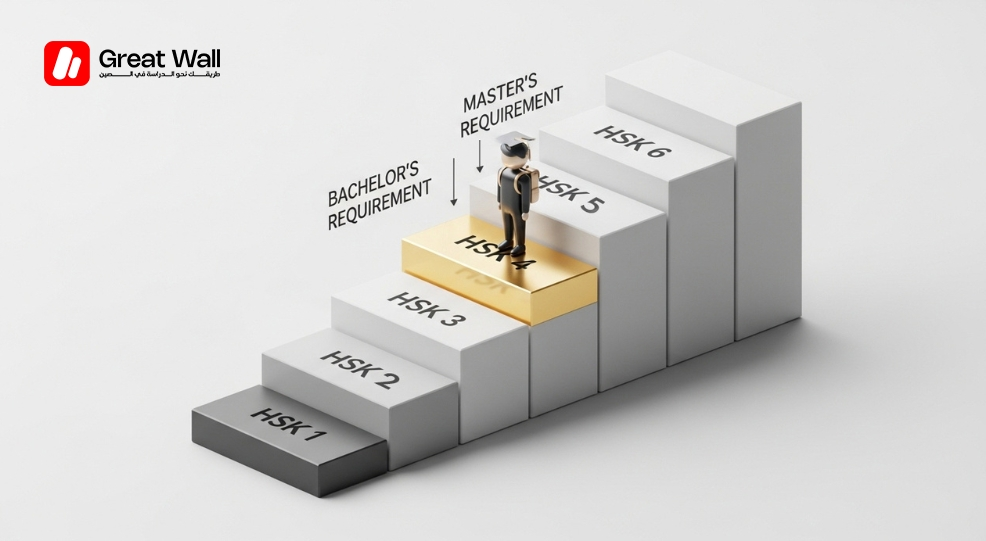
The HSK 4 requirement China is the standard benchmark. This level demonstrates that a student can handle academic content with relative independence.
universities usually expect HSK 5. This is because postgraduate education involves deeper comprehension, academic writing, and active participation in discussions.
The Chinese language requirement university China becomes even more critical. Students are expected not only to understand lectures but also to communicate with patients during clinical training.
If you are unsure how your profile fits these expectations, it is important to align your strategy with your requirements to study in China and your target universities.
One of the most common questions among Moroccan students is whether it is possible to study in China without HSK.
The answer is yes — but only under specific conditions.
Many universities offer English-taught programs, particularly in fields such as business, engineering, and computer science. In these cases, students are not required to take the HSK test but may need to provide proof of English proficiency.
Another pathway is the foundation year, where students spend one year learning Chinese before starting their degree. This option is especially valuable for students who want access to more universities and better integration into Chinese society.
Choosing between these options should be part of a broader strategy that also includes your China scholarships 2026 plan and long-term goals.
For Moroccan students, the HSK exam Morocco is typically organized through Confucius Institutes and partner universities, mainly in cities like Rabat and Casablanca.
Because exam sessions are limited and fill up quickly, planning ahead is essential. Many students underestimate this step and miss important deadlines, which can delay their entire application process.
Official registration and exam schedules are available through Chinese Testing International, which manages HSK exams worldwide.

Preparing for the HSK test requires more than memorizing vocabulary. It involves building a structured learning system that combines reading, listening, and repetition.
Successful students typically follow a consistent daily routine over several months. They gradually expand their vocabulary while reinforcing their understanding through listening exercises and mock exams.
One of the most underestimated aspects of preparation is listening comprehension. Many students focus heavily on memorization but struggle during the listening section, which significantly impacts their final score.
Using tools like Pleco can help accelerate vocabulary acquisition, while spaced repetition techniques improve long-term retention.
When applying for scholarships, especially through the China Scholarship Council, your HSK level can play a decisive role.
Although some programs accept students without HSK, having a strong score significantly increases your chances. It signals to universities that you are prepared, motivated, and capable of integrating academically.
In competitive cases, two students with similar academic profiles may be differentiated primarily by their HSK level.
Many Moroccan students misunderstand HSK requirements China and make strategic errors during their application.
Some apply with an HSK level that is too low, assuming universities will be flexible. Others choose Chinese-taught programs without realistically assessing their language ability.
Another common mistake is ignoring the option to study in China without HSK, which can sometimes be a smarter and more strategic pathway depending on the student’s profile.
Understanding HSK requirements China is not just about meeting a condition; it’s about positioning yourself strategically.
Students who anticipate requirements, prepare early, and align their HSK level with their academic goals gain a clear advantage in both admissions and scholarships.
Whether you choose to apply with HSK or decide to study in China without HSK, the key is to make an informed decision based on your profile, your timeline, and your long-term objectives.
HSK requirements in China typically include HSK 4 for bachelor’s programs and HSK 5 for master’s degrees, depending on the university and field of study.
Yes, you can study in China without HSK by applying to English-taught programs or completing a foundation year in Chinese
HSK is not always mandatory, but having it significantly improves your chances of receiving a CSC scholarship.
HSK 4 is the minimum level required by most universities for undergraduate programs taught in Chinese.
You can take the HSK exam in Morocco in cities like Rabat and Casablanca through Confucius Institutes.
The difficulty depends on the level. HSK 4 is achievable with consistent study, while HSK 5 requires more advanced comprehension and practice.
The Chinese language requirement for universities in China usually ranges from HSK 4 to HSK 5, depending on the program.
For accurate and official information:
Introduction Nanjing University of Aeronautics and Astronautics (NUAA) stands out as one of

Study in China Is a Strategic Choice; Not Just a Backup Plan Study

What is Zhengzhou University? Zhengzhou University is one of China’s largest universities, located