
Majors
Study Chinese Language & Literature in English (2026 Guide)
Introduction Study Chinese Language and Literature in China: it is one of the

Scholarship application and exam preparation support.
Practice tests, strategies, and feedback to help you achieve your target score.
Targeted training and past paper practice to boost your exam performance.
Mock interviews and coaching to help you succeed in admissions and visa interviews.
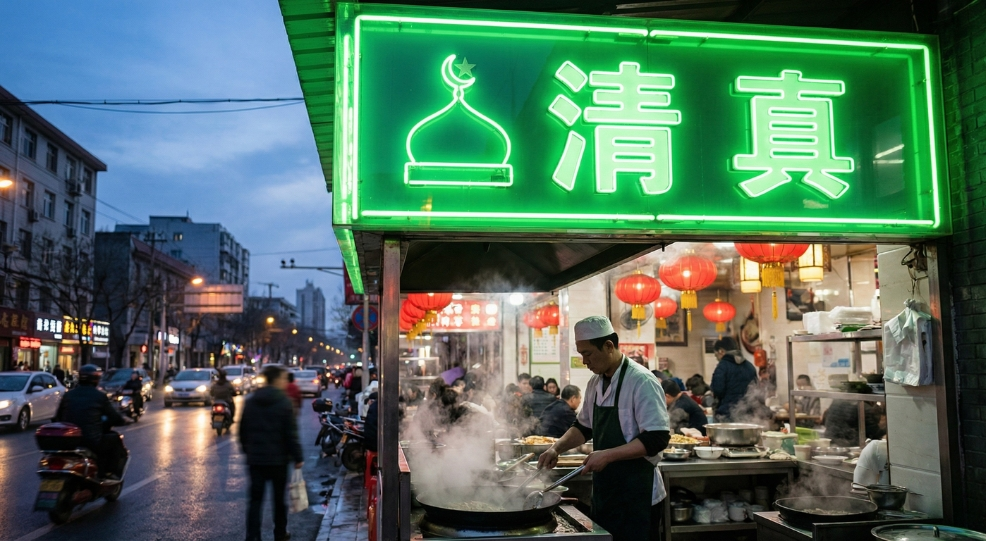

Can you live as a practicing Muslim in China? The answer is a definitive Yes. In fact, in many major Chinese cities, finding Halal food is easier and cheaper than in some parts of Europe. You will not starve, and you will not have to compromise your values.
The stereotype is that Chinese cuisine is 100% haram. You imagine walking into a restaurant, pointing at a vegetable dish, and discovering later it was fried in lard. The fear of accidentally consuming forbidden food is a major stress for Moroccan students.
If you believe you can’t eat anything, you isolate yourself. Meals become solitary affairs cooked in the dorm, while social events are skipped entirely. This self-imposed exile creates a deep sense of alienation, taking a toll on mental health until the inevitable doubt creeps in: “Maybe China wasn’t for me”.
You are not the first Muslim in China. The Hui people (Chinese Muslims) have been there for centuries. They look Chinese, speak Mandarin, but they share your faith. They run thousands of restaurants that strictly follow Islamic dietary laws. You just need to know how to spot them.
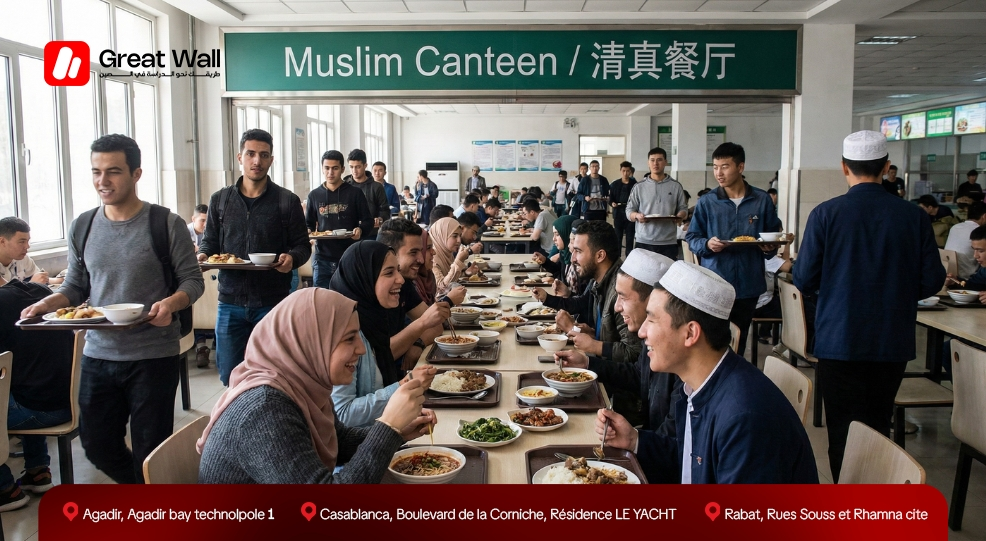
This is your survival code.
In every city, from Shanghai to small towns, you will see restaurants with a Blue or Green sign featuring a picture of a mosque. These are Lanzhou Beef Noodle shops.
This is the biggest surprise for Moroccans. Because China has many Muslim minority students, public universities are required to have a Muslim Canteen (Qingzhen Shitang).
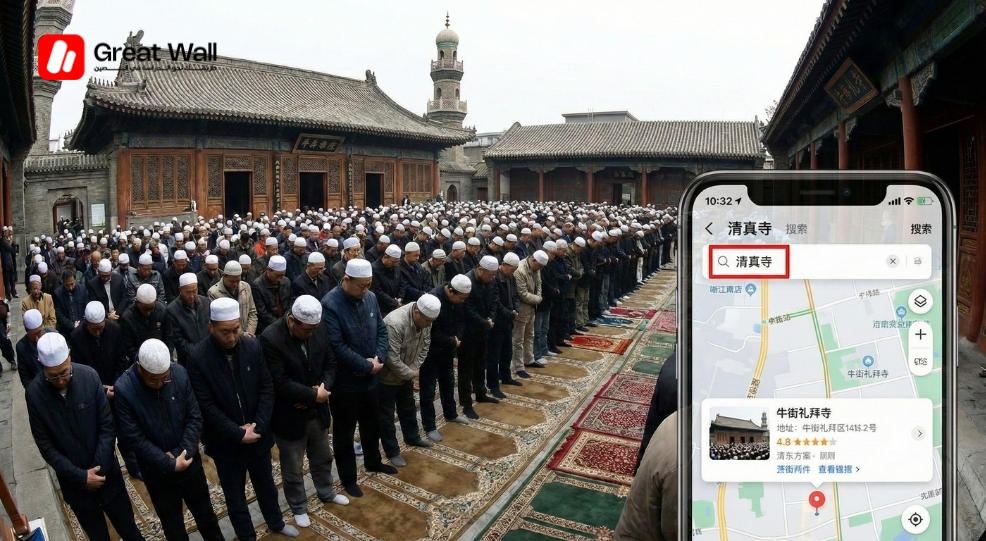
Hamza arrived in Hangzhou in September. He was nervous about his first Ramadan away from his family in Casablanca. He bought a rice cooker, expecting to eat plain rice alone in his room for Suhoor. On the first night of Ramadan, his Pakistani roommate told him, “Let’s go to the canteen.” Hamza was shocked. The canteen was open at 3:30 AM. The lights were on. There were 50 other students—Moroccans, Egyptians, Kazakhs, and Indonesians; eating hot beef noodles and chatting. He realized he wasn’t alone. He found a new “Ummah” (Community) on campus. That Ramadan became his favorite memory because of the brotherhood he found over a bowl of Chinese noodles.
The fear of compromising one’s deen (faith) can be paralyzing. Every meal brings a wave of anxiety, often accompanied by a lingering guilt about the decision to move to a non-Muslim country in the first place.”
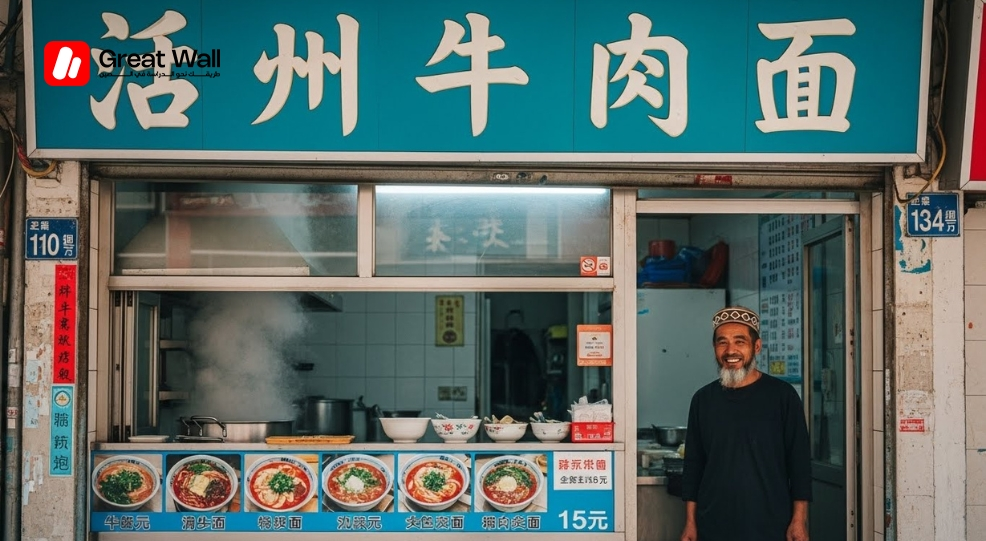
It soon becomes clear that faith is portable. Instead of starvation, daily life involves enjoying spicy, flavorful Halal cuisine and performing Jumu’ah prayers in historic sanctuaries standing for over 1,000 years, such as Beijing’s Niujie Mosque.
The key is choosing a city with a strong Muslim community. Cities like Xi’an, Lanzhou, Yiwu, Guangzhou, and Beijing are fantastic. Cities in the deep south or very rural areas might be harder.
Being a Muslim in China is a unique experience. Living abroad transforms students into cultural ambassadors. Surprisingly, locals show immense respect for dietary restrictions; a simple ‘Wo bu chi zhurou’ (I don’t eat pork) is instantly understood and honored, meaning there is never a need to hide one’s identity.
Are you looking for a university in a city with easy access to Halal food and active mosques? Great Wall Education can guide you. We know which campuses have the best Halal canteens and active international student communities. Contact us to find a “Muslim-friendly” city for your studies.
Generally, NO. Unlike in Morocco, fast food chains in China are not Halal (except in specific regions like Xinjiang or Ningxia). Always stick to the “Qingzhen” restaurants or the Halal canteen.
Yes. In major cities and on university campuses, wearing a Hijab is allowed and common among international students and Hui Chinese women.
China is huge, so prayer times vary. You should download a prayer app (like Muslim Pro) and set the location to your Chinese city to get accurate times.
Pro Tip : Since Chinese URLs are volatile, you can add a small note in the footer: > “Note: Access to specific university intranet pages may require a campus network. The sources above are global travel and education authorities verifying the availability of Halal facilities.”
Introduction Study Chinese Language and Literature in China: it is one of the

Introduction Study MBBS in China; one of the top choices for international students

Introduction Chinese university interview requirements may apply if you are applying to study