study in china
Best Cities to Study in China for Moroccan Students (2026 Complete Guide)
Introduction The best cities to study in China for Moroccan students in 2026

Scholarship application and exam preparation support.
Practice tests, strategies, and feedback to help you achieve your target score.
Targeted training and past paper practice to boost your exam performance.
Mock interviews and coaching to help you succeed in admissions and visa interviews.


If you are a Moroccan student currently enrolled in a public or private university and silently typing “study in China” or “transfer from Moroccan university to China” into Google, you are already at a crossroads.
Most students don’t leave La Fac because they fail. They leave because they understand too late that effort alone is not enough. What matters is where that effort leads.
This guide exists to answer one uncomfortable but crucial question:
Is restarting your studies in China a waste of time, or the smartest correction you can make?
Before emotions, promises, or fear decide for you, read the facts below.
If you are currently enrolled in a Moroccan university and wondering whether leaving is a mistake, you are not alone. Every year, thousands of Moroccan students reach the same conclusion: the system rewards patience, not potential.
This article explains, clearly and without marketing language, how study in China for Moroccan students really works, what the real China requirements are, and why restarting can be a strategic decision rather than a failure.
The problem many Moroccan students face is not lack of intelligence or effort. It is economic reality. Degrees are produced faster than opportunities, and employers increasingly value international exposure and rare skills.
That is why study in China is no longer an alternative; it is becoming a career accelerator. Chinese universities are deeply connected to industry, especially in engineering, logistics, trade, and technology.
Many Moroccan students who study in China return with Mandarin skills and practical experience that immediately differentiate them in Moroccan and international job markets.
For a broader perspective, read why [Study in China as the best option for Moroccan students].
No. Moroccan students cannot directly transfer to Year 2 or Year 3 in Chinese universities.
Chinese universities do not use the European ECTS credit system. Moroccan transcripts are treated as academic background, not transferable credits. Even students with good grades must usually restart as freshmen.
This policy ensures academic consistency and protects the university’s degree standards.
Many agencies avoid saying this clearly because restarting sounds like failure. In reality, restarting is a structural requirement, not a judgment on your ability.
Chinese first-year programs often cover material that Moroccan students only encounter later. From their perspective, restarting ensures equal footing for all students.
But restarting does not mean wasting time, if you understand the system.
To study in China, Moroccan students must meet official China requirements.
These include a valid baccalaureate, university transcripts, a passport, medical examination, police record, and compliance with age limits (usually under 25 for Bachelor’s degrees).
Understanding these requirements early prevents rejection and delays.
Full details are explained in [China requirements for Moroccan students].
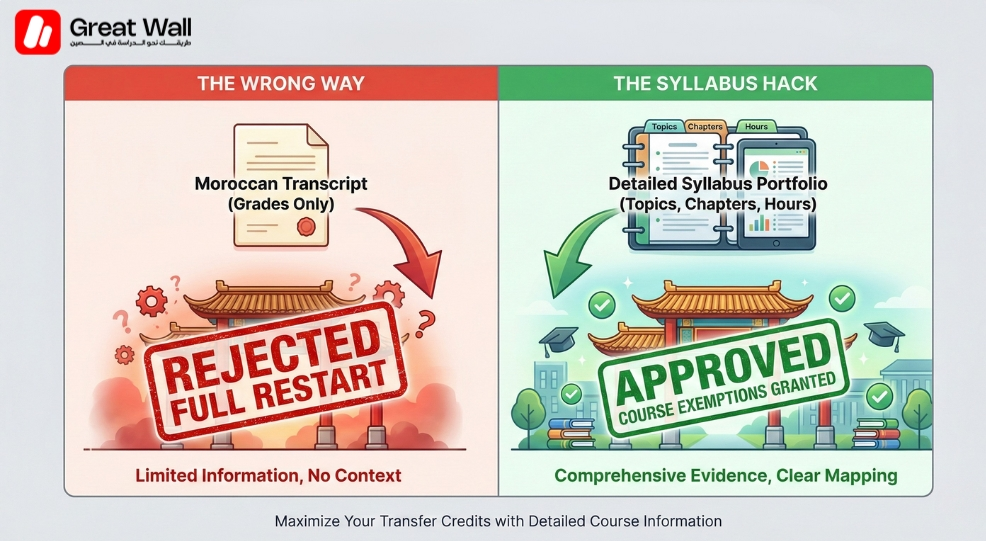
Restarting does not mean repeating subjects blindly. Chinese universities allow course exemptions when prior learning is properly documented.
Most Moroccan students fail here because they bring only grades. Professors want detailed syllabi showing topics, chapters, and depth of study.
When exemptions are approved, students remain officially in Year 1 but are free from repetitive courses. This time can be used to focus on Mandarin, internships, or professional development.
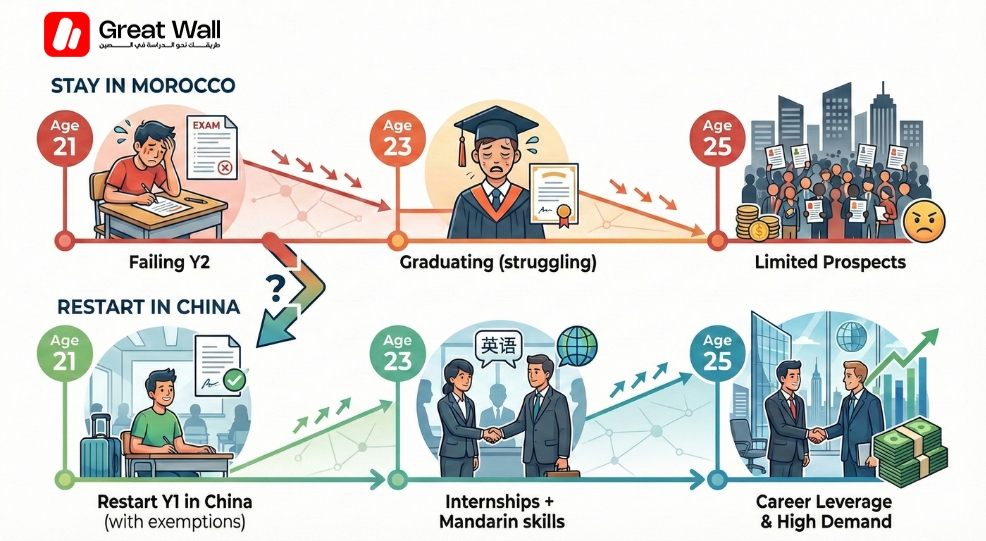
Amine, a 21-year-old Moroccan student in Casablanca, is failing his second year in economics.
If he stays, he may graduate at 25 with limited job prospects. If he restarts and chooses to study in China, he also graduates at 25; but with Mandarin skills and international exposure.
The difference is not age.
The difference is career leverage.
Yes. For many Moroccan students, restarting to study in China leads to higher salaries and faster employment.
Graduating at the same age with a stronger profile is not losing time; it is optimizing it.

This path is not suitable for everyone. Moroccan students who are over 25, unwilling to learn Mandarin, or seeking an easy academic experience should reconsider.
China rewards discipline and long-term commitment.
The years you already spent in Morocco are gone. They are not debts to repay; they are experience.
For many Moroccan students, choosing to study in China is not about escaping Morocco. It is about returning with skills the market actually values.
If you are serious about restarting, Great Wall Education helps Moroccan students:
Contact us for a free evaluation
Yes. Chinese universities focus on eligibility and documentation, not Moroccan academic failure.
For English-taught programs, Mandarin is not required initially, but learning it is essential for jobs and internships.
Yes, with university authorization. Internships are strongly encouraged in later years.
Yes, provided the university is officially accredited and the degree is properly legalized.
In many cases, total costs are comparable or lower, especially with scholarships.
Yes. Restarting often allows Moroccan students to pivot into better fields like trade, logistics, or engineering.
Introduction The best cities to study in China for Moroccan students in 2026
Introduction Cost of studying in China is one of the main reasons why

Introduction CSCA Exam Technical Issues can happen during the test, but they are